


The lamination process for film touch panels primarily employs the line pressing method, with X-Y edge alignment accuracy maintained within 0.2 mm. In addition to the preceding steps of film separation and roller pressing, the laminated product must undergo a debubbling treatment (Auto-clave). The rollers used for lamination are not perfectly circular, and localized glue deficiency may occur in the OCA (Optically Clear Adhesive). Consequently, minute bubbles—such as delayed bubbles and RA bubbles—often appear after the lamination process.
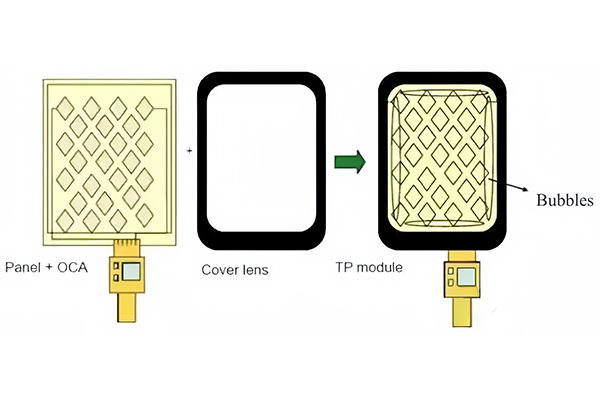
The Auto-clave is set at 50°C and 5 kg/cm² for 30 minutes. Under these conditions, the temperature softens the adhesive, and the applied pressure works to eliminate or disperse bubbles generated during lamination, while also promoting tighter bonding between the product layers. The occurrence of bubbles represents a key competitive factor among panel manufacturers and ranks among the top three defect categories for lamination suppliers. Increasing the viscosity (or softness) of the OCA can, to some extent, reduce bubbles generated during lamination. However, this also raises the risks of adhesive overflow at the cross sectional edges, uneven glue distribution, and folding damage.


